
Quick Answer
The DJI Mic Mini is the best wireless lavalier for podcasters who record away from a desk — interviews, travel, and on-location content at genuine broadcast quality.
For fixed desk recording, the Rode PodMic delivers better audio quality per dollar. Choose the Mic Mini if you ever need to record without being tethered — or if you’re also creating video content.
The DJI Mic Mini is a wireless lavalier system designed for creators, vloggers, and run-and-gun video producers. But its small form factor and excellent audio quality have attracted podcasters who want to record away from a desk — or who need a portable setup that still sounds professional. The question is whether a wireless lavalier can genuinely replace a podcast desk mic.
The short answer: it depends on how you record. For interviews, on-location content, and multi-camera setups, the DJI Mic Mini is hard to beat at this price. For a sit-down home podcast with consistent positioning, a quality desk mic like the Rode PodMic will edge it out on raw audio quality. This review breaks down both scenarios so you can choose the right tool for your specific workflow.
DJI Mic Mini for Podcasting: Our Picks


Full Breakdown
DJI Mic Mini: Wireless Freedom With Real Audio Quality
Design and Build
The DJI Mic Mini comes as a two-transmitter, one-receiver kit with a compact charging case. Each transmitter weighs 4.9 grams — light enough to clip to a collar without the mic pulling fabric. The magnetic clip holds firmly and swivels to position the mic capsule correctly regardless of garment type.
The receiver connects directly to a phone (USB-C or Lightning) or camera (cold shoe mount). No Bluetooth pairing delays — the system connects instantly when you open the charging case. The physical design is clean and minimal, with a discreet charging indicator light.
Audio Quality and Range
The DJI Mic Mini records at 48kHz/24-bit with real-time noise cancellation processing. In quiet to moderately noisy environments, voice clarity is excellent — the mic sits close to the mouth on clothing, which naturally reduces room sound without needing off-axis rejection. The noise cancellation mode adds a slight processing artifact on consonants, but it’s subtle enough for YouTube, social media, and most podcast applications.
Wireless range is listed at 400 meters (open field), though real-world indoor range is closer to 50–80 meters before dropouts occur. For podcasting, you’re rarely more than 10 feet from your phone or camera, so range is never a practical concern.
Who the DJI Mic Mini is For
The DJI Mic Mini is the right choice if you record away from a desk — interviews, travel content, outdoor segments, or event coverage. It’s also ideal if you need to record to your iPhone or Android directly without a computer in the chain. Podcasters who occasionally record video content alongside audio get a significant advantage from the wireless flexibility. This DJI Mic Mini review recommends it specifically for that use case.
Rode PodMic: The Benchmark for Desk Podcast Audio
Why It’s the Desk Comparison
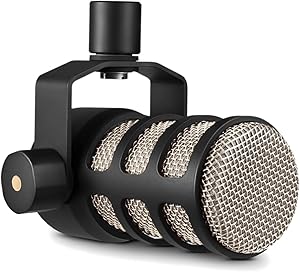
The Rode PodMic is included here as the reference point for what a dedicated desk podcast mic delivers. At roughly the same price as a DJI Mic Mini kit, the PodMic represents the ceiling of single-voice XLR audio quality under $100 — and it sets the standard that the Mic Mini is measured against for sit-down recording. The DJI Mic Mini review compares it directly against this benchmark.
Sound Quality in Context
In a fixed home studio setup, the PodMic will consistently outperform the Mic Mini on tonal quality and off-axis rejection. The cardioid dynamic capsule with its internal shock mount captures voice with warmth and body that the Mic Mini’s small lavalier capsule can’t fully match. For long-form solo podcasting where audio quality is the primary concern, the PodMic wins.
The Tradeoff
The PodMic requires an audio interface, a boom arm, and a fixed recording position. You can’t move, you can’t record to a phone without additional gear, and you can’t clip it to your shirt and walk around. For podcasters who never leave their desk, that’s fine. For everyone else, the constraint is real.
Fifine AM8: The Flexible Middle Ground
USB Convenience Without Sacrificing Quality
The Fifine AM8 covers the use case where someone needs a desk mic but doesn’t want the complexity of an XLR setup. The USB-C connection means it’s plug-and-play on any computer, and the built-in headphone monitoring jack adds functionality that the PodMic lacks.
How It Compares to the DJI Mic Mini
In a direct audio comparison, the AM8 via USB sounds comparable to the DJI Mic Mini in controlled conditions — both deliver clean, warm dynamic audio with good noise rejection. The AM8 is better if you record at a desk and want to avoid the per-recording friction of clipping on a lavalier, charging transmitters, and carrying the case. The Mic Mini is better if you ever need to record away from that desk.
Can a Wireless Lavalier Actually Replace Your Desk Mic?
For most podcasters who record purely at a desk, no — a dedicated desk mic like the PodMic delivers better tonal quality and more consistent positioning. But for podcasters who also create video content, interview guests in person, or want to record anywhere in their home without being tethered to a setup, the DJI Mic Mini is not a compromise. It’s a different tool that genuinely matches the desk mic at portable use cases while enabling recordings that a desk mic simply can’t do.
The deciding question is: do you ever record away from your desk? If yes, the Mic Mini earns its price. If no, the PodMic or AM8 will serve you better on audio quality per dollar. This DJI Mic Mini review covers both use cases so you can decide confidently.
FAQ: DJI Mic Mini for Podcasting
Does the DJI Mic Mini work for podcasting without a camera? +
Yes — the DJI Mic Mini connects directly to a smartphone via USB-C or Lightning, or to a computer via the receiver’s USB-C output. You can record directly into GarageBand, Audacity, Riverside, or any recording app. No camera is required.
How does the DJI Mic Mini handle background noise? +
The Mic Mini has a built-in noise cancellation mode that reduces HVAC, traffic, and ambient room noise effectively. The physical proximity of the lavalier to your mouth (clipped to collar or lapel) also helps naturally reduce room ambience. It handles moderate background noise well — better than most desk mics at the same price in noisier environments.
Is the Rode PodMic too hard to set up for beginners? +
Not if you buy it with a compatible audio interface. The Focusrite Scarlett Solo is the most common pairing and requires three steps: connect the interface to your computer via USB, connect the PodMic to the interface via XLR, and select the interface as your audio input in your recording software. Setup takes under 10 minutes.
Can I use the DJI Mic Mini for a two-person podcast? +
Yes — the kit includes two transmitters, so each person clips on their own mic. The receiver records both channels, which can be split in post-production for separate editing. This is actually one of the DJI Mic Mini’s strongest use cases for podcasting: portable two-person recording without cables.
Is the DJI Mic Mini good for podcasting? +
Yes — for portable and on-the-go podcasting. The DJI Mic Mini is a wireless lapel system that clips to your shirt, giving you freedom of movement without cable noise. Audio quality is solid for a wireless system, though it doesn’t match a dedicated studio dynamic or condenser mic. It’s best for interviews, video podcasts, and recording outside a studio.
How does the DJI Mic Mini compare to a USB desk mic for podcasting? +
They serve different use cases. A USB desk mic like the Blue Yeti or Shure MV7 gives you better audio quality and easier desktop setup. The DJI Mic Mini wins when recording on location, moving around, or doing video content — its wireless convenience is unmatched at this price point.
Related reading: Fifine AM8 vs Rode PodMic: Best Dynamic Mic Under $100? · Elgato Wave DX Review: The Dynamic XLR Mic That Needs No Preamp Boost · Shure MV7+ Review: The Upgraded USB/XLR Podcast Mic That Gets Everything Right