
The dynamic vs condenser mic for podcasting question gets answered backwards almost everywhere. The usual framing is that condensers are the “better,” more professional microphone and dynamics are the budget compromise — so people buy a condenser, record in an ordinary bedroom, and end up with a track full of room echo, keyboard clatter, and the neighbour’s dog.
Here is the honest version: the right answer depends on your room, not your budget. Both types can sound excellent. They just fail in different ways. A dynamic mic hears mostly what is directly in front of it. A condenser hears everything, faithfully — including all the things you wish it would not.
This guide explains what actually separates the two, which one suits the space you are recording in, and the mics worth buying once you have decided.
- Record in an untreated room? Get a dynamic. Bedroom, office, apartment — anywhere with bare walls or background noise. That is roughly 90% of podcasters.
- Record in a quiet, treated space? A condenser rewards you with more detail and air, and is the better pick for voice-over-style polish.
- Not sure? Buy the dynamic. It is the forgiving option, and a dynamic in a bad room beats a condenser in a bad room every time.
- Already treated your room and want maximum detail? That is the one case where the condenser is clearly the upgrade.
Bottom line: dynamics reject your room, condensers capture it. Fix the room, or pick the mic that ignores it.
The Picks for Each Type
Two dynamics and two condensers worth buying once you know which type you need. For the full lineups, see our dedicated roundups linked further down.

- Dynamic capsule rejects room echo and background noise
- USB and XLR in one mic
- Onboard gain, mute and monitoring
- Outstanding value for a first mic
- Plastic build
- Basic bundled accessories
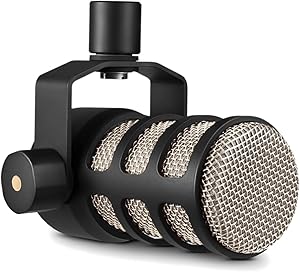
- Rich, radio-ready voice tone
- Internal pop filter and shock mounting
- Built like a tank
- The value benchmark in podcasting
- XLR only — needs an interface
- Heavy; wants a sturdy arm

- Crisp, detailed and airy on voice
- Long-standing studio staple
- Affordable entry into condensers
- Excellent in a quiet room
- Captures the whole room — punishing if untreated
- Needs phantom power and an interface

- Extremely low self-noise
- XLR and USB outputs in one mic
- 32-bit float capture makes clipping recoverable
- Superb vocal detail
- Most expensive pick here
- Ruthlessly reveals a bad room
- Overkill for a casual show
Dynamic vs Condenser at a Glance
| Factor | Dynamic | Condenser |
|---|---|---|
| Room echo | Rejects it — forgiving | Captures it — unforgiving |
| Background noise | Largely ignores it | Picks up fans, keyboards, traffic |
| Detail / “air” | Warmer, more focused | Crisper, more detailed |
| Power needed | None beyond the interface | Phantom power (+48V) |
| Mic technique | Requires close, consistent placement | More forgiving on distance |
| Best room | Untreated bedroom, office, apartment | Quiet, treated or soft-furnished space |
| Typical podcast use | About 90% of shows | Voice-over polish, treated studios |
| Our picks | FIFINE K688 · RØDE PodMic | Audio-Technica AT2020 · RØDE NT1 |
What Actually Separates a Dynamic From a Condenser
A dynamic microphone uses a moving coil that needs real sound pressure to register — which makes it inherently less sensitive, and that insensitivity is the feature. It hears what is loud and close (your voice) and largely ignores what is quiet and distant (the room). A condenser uses a lightweight diaphragm and a powered circuit, making it far more sensitive and detailed. It captures more of everything: more nuance in your voice, and more of the space around you. Neither is objectively better. One is selective, one is faithful. Podcasting usually rewards selective.
Why Your Room Decides This, Not Your Budget
The single biggest variable in how a podcast sounds is not the microphone — it is the space. Bare walls, hard floors, and a ceiling reflect your voice back at the mic milliseconds later, and that is the hollow, distant quality that marks amateur audio. A condenser records those reflections faithfully. A dynamic, positioned close, mostly misses them. This is why a $70 dynamic in a normal bedroom routinely beats a $300 condenser in the same room. See our guides to recording in untreated rooms, noisy apartments, and reducing echo at home.
When a Condenser Is Genuinely the Right Call
Condensers earn their place when the room is under control: a treated space, a closet with clothes, a room with rugs, curtains and soft furniture, and no HVAC or traffic noise. In that environment the extra detail and top-end air are a real upgrade, especially for narrative and voice-over-style shows where polish matters more than resilience. If you are willing to do acoustic treatment first, a condenser is a legitimate step up rather than a mistake.
How to Choose in 30 Seconds
Stand where you record and clap once. If you hear a short, sharp sound that dies immediately, your room is reasonably controlled and a condenser is on the table. If you hear a ring, a slap-back, or the sound smearing out, buy a dynamic and do not think about it again. Then add the second question: can you hear a fan, a fridge, traffic, or people through the wall? If yes, dynamic — regardless of how the clap sounded.
Where Connection Type Fits In
Dynamic vs condenser is a separate decision from USB vs XLR, and mixing them up causes a lot of bad purchases. Both types come in both connections, and several mics here do both. Sort out the acoustic question first, then read our USB vs XLR guide to decide how it plugs in. Worth noting: condensers on XLR need phantom power, so your interface must supply +48V.
Ready to Pick a Specific Mic
Once you know the type, the full lineups live in our dedicated roundups — best dynamic microphones for podcasting and best condenser microphone for podcasting. If you are weighing two specific condensers, we also compare the RØDE NT1 vs Audio-Technica AT2020 directly.
Frequently Asked Questions
Is a dynamic or condenser mic better for podcasting?
For most podcasters, dynamic. A dynamic microphone rejects room echo and background noise, which matters more than raw detail when you are recording in an ordinary room. Condensers are better only when your space is quiet and acoustically treated.
Why do condenser mics sound bad in my room?
They do not — they sound accurate, and your room is the problem. Condensers are highly sensitive, so they faithfully capture wall reflections, computer fans, and street noise along with your voice. A dynamic mic ignores most of that by design.
Do I need phantom power for a condenser mic?
Yes. XLR condensers require +48V phantom power, supplied by your audio interface or mixer. Dynamic microphones do not need phantom power, though some low-output dynamics benefit from extra preamp gain.
Can I use a condenser mic for podcasting if I treat my room?
Absolutely. With acoustic treatment — or even a small, soft-furnished space like a closet — a condenser delivers more detail and air than a dynamic. Treatment first, condenser second; doing it in the other order is what disappoints people.
Is a dynamic mic worse quality than a condenser?
No. They are different tools, not different tiers. Broadcast studios and radio have used dynamics for decades because focused, room-rejecting sound is exactly what spoken word needs. “Worse” usually means “less detailed,” and less detail is often an advantage in an untreated room.
Which is better for recording two people in one room?
Dynamics, clearly. Two condensers in one room will each pick up the other person and the space between you, causing bleed and phase issues. Two dynamics, placed close to each speaker, keep the voices separated and much easier to edit.