
For years, the default answer to “what’s the cheapest dynamic mic actually worth buying for a podcast?” was the Audio-Technica ATR2100x. That mic is still sold, but stock has turned unreliable — listings routinely show only a handful of units — which left a real gap: a sub-$80 dynamic with both USB and XLR outputs that doesn’t punish you for recording in a normal room. This FIFINE K688 review covers the mic that fills it.
The K688 is a cardioid dynamic with a USB-C output for plug-and-play recording today and an XLR output for the interface you might buy later — plus onboard controls the old budget benchmarks never had: a gain knob, a touch-sensitive mute, and a zero-latency headphone jack. It’s the budget pick we now recommend across our under-$100 roundup and our guides to recording in untreated rooms.
Below: how it actually sounds for spoken word, where it beats the Samson Q2U and FIFINE’s own AM8, where it falls short, and who should buy it.
Quick Verdict
FIFINE K688 — 8.5/10. The best all-around budget USB/XLR dynamic you can buy right now — room-rejecting capsule, onboard controls, and a shock mount in the box for under $80.
Samson Q2U — Budget alternative. Still a great starter — pick it over the K688 only if you find it meaningfully cheaper.
FIFINE AM8 — For streamers. The same USB/XLR flexibility with RGB lighting and gamer styling.
RØDE PodMic — The $99 step-up. Noticeably better broadcast sound if you already own an interface.
Our Top Picks

- Dynamic cardioid capsule rejects untreated-room echo and background noise
- USB-C today, XLR when you upgrade — one mic across your whole journey
- Onboard gain knob, touch-mute, and zero-latency headphone monitoring
- Metal body and included shock mount at a sub-$80 price
- Touch-sensitive mute is easy to brush by accident
- 16-bit USB capture — fine for podcasts, limiting for music
- Still a budget dynamic — don’t expect PodMic warmth
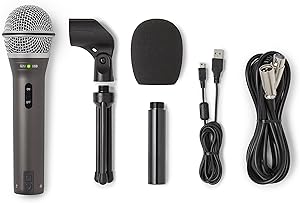
- Dynamic capsule handles untreated rooms better than budget condensers
- USB and XLR outputs — interface-ready when you upgrade
- Built-in headphone jack for zero-latency monitoring
- Ships with desk stand, clip, and both cables
- No gain control or mute on the mic itself
- Thin high end on bright voices
- Plastic body feels its price

- Same dual USB-C/XLR outputs as the K688
- Tap-to-mute, gain control, and headphone monitoring
- RGB lighting that streamers actually want
- Frequently the cheapest USB/XLR dynamic on sale
- Gamer styling looks out of place in a podcast studio
- Included desk stand encourages bad mic technique
- A touch behind the K688 on vocal fullness
| Mic | Price | Connection | Onboard Controls | Our Score |
|---|---|---|---|---|
| FIFINE K688 | ~$60 | USB-C + XLR | Gain · mute · monitoring | 8.5 |
| Samson Q2U | ~$70 | USB + XLR | Monitoring only | 8.3 |
| FIFINE AM8 | ~$55 | USB-C + XLR | Gain · mute · RGB | 8.0 |
Full Breakdown
FIFINE K688 Review: What You’re Actually Getting
The spec sheet that matters
The K688 is part of FIFINE’s AmpliTank line — the studio-styled siblings of its AmpliGame mics. Per FIFINE’s official specs: a dynamic cardioid capsule, USB-C and XLR outputs, 70 Hz–15 kHz frequency response tailored for voice, −58 ±3 dB sensitivity with a 130 dB max SPL, and 16-bit/44.1–48 kHz capture over USB. In the box: shock mount, windscreen, an 8.2 ft USB-C cable, and a 5/8″ to 3/8″ thread adapter. Street price floats between $50 and $80 depending on promotions.
The spec that matters most is the capsule type. Almost everything else at this price is a condenser, and condensers amplify every flaw in an untreated room. The K688’s dynamic capsule focuses on what’s directly in front of it — exactly what you want in a spare bedroom, office, or noisy apartment.
How it sounds for podcasting
Worked close (3–6 inches), the K688 delivers a clean, mid-forward spoken-word sound with usable low-end warmth. Against the Samson Q2U it’s slightly fuller and less brittle in the upper mids, with a comparable noise floor over USB. Neither will be mistaken for an SM7B — airy voices can read a little flat — but plosive handling with the included windscreen is solid, and the room rejection is the real win. Over XLR into a basic interface it picks up extra headroom and polish.
Who it’s for: first-time podcasters in untreated rooms, anyone who has struggled to actually get hold of an ATR2100x, and two-host shows that need a second decent dynamic without blowing the budget.
Samson Q2U
The longtime default, honestly compared
The Q2U has anchored budget mic lists for a decade, and it still earns the spot: a dynamic USB/XLR hybrid with headphone monitoring and a complete kit in the box. What it lacks against the K688 is control — no gain knob, no mute — and its plastic body and thinner top end feel dated next to the K688’s metal build. If the two are the same price, the K688 is the better mic; if the Q2U is meaningfully cheaper on the day, it remains a perfectly honest starting point.
Who it’s for: buyers who find it on sale, and anyone who wants the most-reviewed, most-documented budget mic in podcasting.
FIFINE AM8
Same idea, streamer skin
The AM8 is FIFINE’s gaming-line take on the same formula — dynamic capsule, USB-C and XLR, on-mic controls — dressed in RGB. It trades the K688’s studio look and shock mount for lighting and a desk stand. For a camera-facing stream setup that’s a fair trade; for a podcast studio it isn’t. We’ve compared it directly against the $99 class in our FIFINE AM8 vs RØDE PodMic head-to-head, and the broader lineup in our FIFINE AmpliTank roundup.
Who it’s for: streamers and gamers who want the budget USB/XLR formula with lighting to match the rest of the desk.
What to Know Before Buying
Is 16-bit USB capture a problem?
For podcasting, no. Published episodes are compressed audio streams; 16-bit/48 kHz capture is beyond what listeners can distinguish for spoken word. The capsule type and your room matter far more than bit depth. If you also record music, plan on the XLR output into a 24-bit interface instead.
When to step up to the RØDE PodMic
If you already own an interface — or you’re ready to buy one — the $99 PodMic delivers noticeably warmer, more broadcast-ready sound than any USB-capable budget dynamic. See our full XLR microphone roundup for that tier. The K688’s advantage is that it doesn’t force the choice: start over USB, add the interface later.
Frequently Asked Questions
Is the FIFINE K688 good for podcasting?
Yes — at its price it’s the strongest all-around choice for spoken word. The dynamic cardioid capsule rejects room echo and background noise far better than the budget condensers usually recommended to beginners, and the dual USB-C/XLR outputs mean it works with or without an audio interface.
FIFINE K688 or Samson Q2U — which should I buy?
The K688 in most cases. It adds a gain knob, touch-mute, headphone volume control, a metal body, and an included shock mount over the Q2U for roughly the same money. The Q2U remains a fine pick if you find it meaningfully cheaper.
Does the FIFINE K688 need an audio interface?
No. Over USB-C it’s fully plug-and-play with no drivers. The XLR output is there for when you upgrade to an interface later — both outputs use the same capsule.
Is 16-bit audio good enough for a podcast?
Yes. Published podcasts are compressed audio streams; 16-bit/48 kHz capture is beyond what listeners can distinguish for spoken word. Capsule type and room treatment matter far more than bit depth.
What comes in the box with the K688?
The microphone, a shock mount, a windscreen, an 8.2 ft USB-C to USB-A cable, and a 5/8 to 3/8 inch thread adapter for boom arms. There’s no desk stand — plan on a boom arm, which is better technique anyway.
Can the K688 handle loud voices?
Yes — with a 130 dB max SPL and an adjustable gain knob it won’t distort on energetic delivery. Pull the gain down and work the mic at 3–6 inches.