
Not every podcast is recorded at a desk with a boom arm and an interface. Some of the best shows are built around in-person interviews, field recordings, travel content, or live event coverage — situations where you need a mic, a recorder, and a battery, and nothing else. That’s where portable audio recorders come in.
The Zoom H-series has dominated this space for years, and for good reason: they’re purpose-built for location recording, they accept XLR inputs, they record to SD cards independently of any computer, and they double as USB audio interfaces when you’re back at your desk. If you’ve been wrestling with laptop-dependent setups in the field, or you want a backup recording system for in-person guest sessions, this guide covers what’s actually worth buying.
Quick Picks
Best Overall: Zoom H5 — Modular capsule system, dual XLR/TRS inputs, proven field performance
Best for Multi-Guest: Zoom H6essential — 4 XLR inputs, 6 tracks, 32-bit float, 2024 model
Best Value: Zoom H4essential — 32-bit float technology at entry-level price, compact 4-track
Best for Simplicity: Tascam DR-40X — Reliable dual XLR inputs, no-frills 4-track workhorse
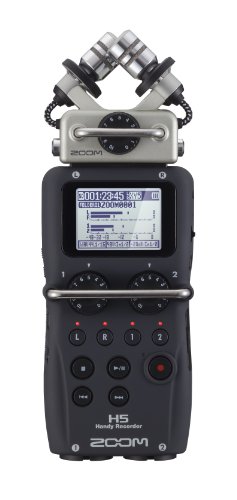
- Two XLR/TRS combo inputs with 48V phantom power for any condenser mic
- Interchangeable modular capsule system for stereo, shotgun, or mid-side recording
- USB interface mode works as 2-in/2-out audio interface
- 24-bit/96kHz recording to SD card, no computer required
- Compact enough for handheld use or tabletop tripod mounting
- No 32-bit float recording (newer models have it)
- Runs on AA batteries — no built-in rechargeable
- Limited to 2 XLR inputs; not suited for 3+ person recordings
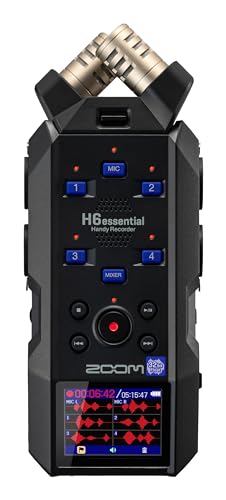
- Four XLR/TRS combo inputs handle up to 4 external mics simultaneously
- 32-bit float recording eliminates clipping risk in unpredictable environments
- 6-track simultaneous recording with built-in stereo capsule as backup
- USB interface mode for 6-channel audio over USB
- Headphone output with full mix monitoring
- Most expensive option on this list
- Larger and heavier than 2-input recorders
- 32-bit float benefits mainly matter in live or uncontrolled environments
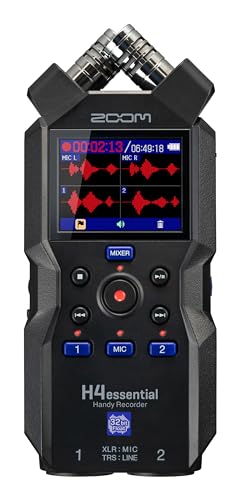
- 32-bit float recording prevents clipping without manual gain management
- Two XLR/TRS combo inputs with 48V phantom power
- Built-in XY stereo mics for ambient or backup tracks
- USB-C power and audio interface mode
- Compact, lightweight, easy to pack for travel
- 32-bit float files require compatible software (Audacity, Reaper, Adobe Audition)
- No modular capsule system
- Limited to 2 external inputs for guest recording
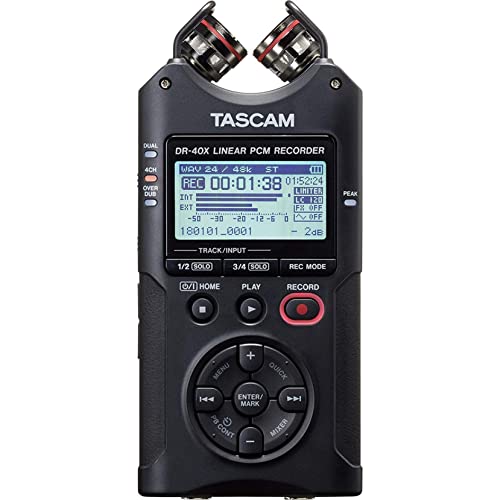
- Two XLR/TRS combo inputs with 48V phantom power
- Adjustable built-in stereo mics for versatile pickup patterns
- 4-track mode with safety backup recording at lower level
- Solid, durable build with minimal complexity
- USB interface mode for desktop recording
- No 32-bit float — requires manual gain management
- Older design compared to current Zoom essential series
- Built-in mics adequate but not exceptional
Quick Comparison
| Recorder | Best For | Type | Price | Score |
|---|---|---|---|---|
| Zoom H5 | Best Overall | 4-Track XLR | ~$280 | 9.2 |
| Zoom H6essential | Best Multi-Guest | 6-Track XLR | ~$330 | 9.4 |
| Zoom H4essential | Best Value | 4-Track 32-bit Float | ~$220 | 8.9 |
| Tascam DR-40X | Best Simplicity | 4-Track XLR | ~$220 | 8.5 |
Best Portable Audio Recorder: Full Breakdown
Best Portable Audio Recorder: Zoom H5 Best Overall
The H5 is the recorder that keeps showing up in serious podcasters’ bags because it genuinely handles every field recording scenario without a weak point. The modular capsule system on top lets you swap between a matched stereo pair for ambient or interview recording, a shotgun capsule for directed capture in noisy environments, and a mid-side capsule if you do any post-production work. Two combo XLR/TRS inputs handle any condenser or dynamic mic you point at a guest. The USB interface mode turns it into a 2-in/2-out desktop interface when you’re back at your desk. Everything about the H5 is designed for the podcaster who records everywhere.
- ✓Two XLR/TRS combo inputs with switchable 48V phantom power
- ✓Modular capsule system with stereo, shotgun, and mid-side options
- ✓USB interface mode for 2-in/2-out desktop recording
- ✓24-bit/96kHz recording, SD card storage, AA battery powered
- ✓Compact, tripod-mountable, rugged enough for field use
- ✗No 32-bit float — requires setting levels before recording
- ✗AA battery operation only, no USB-C charging
- ✗2 XLR inputs maximum — not suitable for 3+ person panels
Zoom H6essential Best Multi-Guest
If you record panels, roundtable discussions, or live podcast events, the H6essential is the tool built for it. Four combo XLR/TRS inputs plus the built-in stereo capsule give you six simultaneous recording tracks — enough to isolate every guest on their own channel, run an ambient room track, and still have headroom for a safety backup. The 2024 32-bit float format removes gain staging from the equation entirely: no clipping regardless of how loud a guest gets, no noise floor problems if someone speaks quietly. For recording in hotels, event venues, or any space where you can’t control the acoustics or the talent’s mic technique, 32-bit float is a genuine insurance policy.
When evaluating what makes the best portable audio recorder, we looked at preamp quality, noise floor, and file format support.
- ✓Four XLR/TRS combo inputs for up to 4 simultaneous external mics
- ✓32-bit float recording eliminates clipping risk in unpredictable settings
- ✓6-track simultaneous recording with built-in stereo capsule as safety backup
- ✓6-channel USB audio interface mode for desktop use
- ✓Full mix headphone monitoring output for all active tracks
- ✗Most expensive recorder on this list by a clear margin
- ✗Larger and heavier than 2-input options — not as easily pocketed
- ✗32-bit float advantages are most relevant in uncontrolled environments
Zoom H4essential Best Value
The H4essential is what happens when Zoom brings 32-bit float recording to their most accessible price point. Two combo XLR/TRS inputs, built-in XY stereo mics, and 4-track simultaneous recording cover the most common podcast field recording scenarios — solo recording, single-guest interviews, and ambient capture. The 32-bit float format is the meaningful upgrade from the H4n Pro it replaces: you no longer need to manage levels before recording, which matters in situations where guests talk unpredictably or you’re rushing to capture something. At around $220, it offers better recording technology than the H5 at a lower price — the tradeoff is no modular capsule system.
- ✓32-bit float recording — no clipping, no noise floor issues
- ✓Two XLR/TRS combo inputs with 48V phantom power
- ✓Built-in XY stereo mics for ambient or backup tracks
- ✓USB-C power and 4-channel audio interface mode
- ✓Compact, lightweight, travel-ready form factor
- ✗No modular capsule system like the H5
- ✗32-bit float files need compatible software to edit
- ✗Limited to 2 external XLR inputs
Tascam DR-40X Best Simplicity
The DR-40X has been in production long enough to earn a quiet reputation among location recorders who need something that works without surprises. Two XLR/TRS combo inputs handle any mic setup. The adjustable built-in stereo mics can be set to XY or AB patterns depending on the recording situation. A 4-track mode captures both main inputs and a safety backup at a lower level — useful when you can’t monitor levels in real time. None of this is cutting-edge: no 32-bit float, no modular system. But the DR-40X does exactly what it’s supposed to do, every time, without requiring setup knowledge or menu diving. For podcasters who want a recorder that records and stays out of the way, that consistency has real value.
The best portable audio recorder models covered here are trusted by both hobbyist and professional podcasters alike.
- ✓Two XLR/TRS combo inputs with phantom power
- ✓Adjustable built-in stereo mics — XY or AB pattern
- ✓4-track safety backup recording at reduced level
- ✓Auto-record and self-timer functions
- ✓Compact, durable, minimal learning curve
- ✗No 32-bit float — manual gain management required
- ✗Older design, no USB-C charging
- ✗Built-in mics are functional but not the highlight
Best Podcast Audio Recorder: What Makes One Worth Buying
When people search for a “podcast audio recorder,” they usually mean one of two things: a standalone handheld recorder they can take on the road, or a small desktop recorder that doesn’t require a laptop. Both are valid use cases, and the options below cover both.
For solo podcasters recording interviews on location, the Zoom H5 or H6 are the gold standard podcast audio recorders — they accept XLR mics, have excellent built-in preamps, and produce broadcast-ready audio straight to SD card. For duo or panel recordings away from a studio, the Zoom PodTrak P4 is purpose-built as a podcast audio recorder with four XLR inputs, pad channels for sound effects, and USB passthrough so it doubles as an interface when you’re back at your desk.
The key thing that separates a great podcast audio recorder from a generic field recorder is preamp quality and usability under pressure. Field recorders optimize for capturing ambient sound; podcast audio recorders optimize for voice — tighter preamps, better limiting, and simpler gain staging.
What to Look for in a Portable Audio Recorder for Podcasting
Specs don’t tell you what you need to know. Input count, bit depth, and sample rate are real numbers — but none of them tell you how a recorder will handle a two-person interview in a hotel room, or whether you’ll be fumbling with menus when the conversation starts. Here’s what actually matters.
Portable Recorder vs. Laptop Plus Interface: Which Is Better for Field Recording?
A laptop with an audio interface is a more powerful setup on paper — more processing, more software options, larger storage. In the field, it’s a liability. Cables, USB power dependencies, boot time, software crashes, fan noise: every one of those is a failure point that doesn’t exist in a battery-powered standalone recorder. A portable recorder starts recording in seconds, runs independently of any computer, stores directly to an SD card, and has no moving parts to introduce noise. The tradeoff is that you’re limited to the recorder’s built-in preamps and no real-time software processing. At the H4essential and H5 level, those preamps are more than adequate for podcast audio. If you’re recording anywhere that power access or desk stability isn’t guaranteed, a portable recorder is the more reliable tool.
How Many Inputs Do You Actually Need?
The honest answer for most podcasters is two. A solo podcaster needs one input. A two-person interview needs two inputs, one per guest. That covers the H5, H4essential, and DR-40X. Panels and group recordings are where you need to think carefully: three people require at least three inputs, and the only recorder on this list that handles that is the Zoom H6essential with its four XLR inputs. Don’t buy more inputs than you need. The H4essential at $220 covers ninety-five percent of podcast field recording scenarios. Only move to the H6essential if you regularly record three or more people simultaneously, because the extra inputs come at a significant cost and size increase.
Using a Portable Recorder as a USB Audio Interface
Every recorder on this list doubles as a USB audio interface when connected to a computer. This means you can use it as your permanent desktop setup and take it into the field when needed — one device instead of two. The H5 and H4essential work as 2-in/2-out USB interfaces; the H6essential works as a 6-in/6-out interface. The latency and audio quality are comparable to dedicated interfaces at similar price points. The practical limitation is that you’re using a field recorder at a desk — it works, but the form factor is less ergonomic than a dedicated interface. For podcasters who want one device that covers both studio and field use, the H4essential is currently the most practical dual-purpose investment.
Battery Life and Storage: What to Know Before You’re in the Field
The H5 and H4essential use two AA batteries and typically deliver six to eight hours of recording with phantom power active, or fifteen-plus hours without. The H6essential uses four AAs with similar runtime. Always bring spare batteries — lithium AAs perform significantly better than alkaline in cold conditions and have a longer shelf life for storage. For SD cards: a 32GB card holds roughly 200 hours of 24-bit/44.1kHz audio, far more than any field session requires. The main consideration is card speed — use cards rated for audio and video recording (Class 10 or U1 minimum) to prevent write-speed errors during high-track-count sessions.
Best Portable Audio Recorder Under $100 and Under $200
At the under $100 price point, the Zoom H1n and Tascam DR-05X are the most reliable options for podcasters who need a grab-and-go field recorder. Both record stereo audio at 24-bit quality and run on AA batteries. The H1n is slightly more compact; the DR-05X has a more durable build quality. Neither has XLR inputs at this price, so you are limited to the built-in stereo microphones or a 3.5mm input.
In the under $200 range, the Zoom H4n Pro and Tascam DR-40X both offer built-in stereo mics plus two XLR combo inputs with phantom power. This unlocks the ability to connect external mics or lavaliers, which is a major step up for interview-style podcast recording in the field.
Zoom vs Tascam vs Sony: Which Brand Makes the Best Portable Recorder?
Zoom dominates the portable recorder market for podcasters and musicians alike. The H-series recorders are widely supported, have large user communities, and offer strong firmware update histories. The Zoom H5 and H6 in particular are considered industry standards for field recording and podcast interviews.
Tascam produces quieter preamps at comparable price points, which is a meaningful difference when recording in challenging environments. The DR-40X and DR-701D are popular with videographers and journalists who prioritize signal quality. Sony recorders like the PCM-A10 are compact and build-quality focused, but they carry a price premium and have a smaller accessory ecosystem than Zoom or Tascam.
Portable Audio Recorder vs Audio Interface: Which Do You Actually Need?
An audio interface connects to your computer and routes microphone audio into your recording software. A portable audio recorder captures audio independently as standalone WAV or MP3 files to an SD card — no computer required during recording. The right choice depends entirely on where and how you record.
If you record in a fixed studio setup and always have your laptop nearby, an audio interface with a good XLR microphone is almost always the better investment. If you record in the field — at conferences, in vehicles, or at remote locations — a portable recorder gives you freedom from a power outlet and a laptop. Many podcasters own both: an interface for studio sessions and a Zoom H5 or H6 for remote recording.
Best Portable Audio Recorder for Remote Podcast Interviews
For interview-style podcast recording in the field, the ideal portable recorder has at least two XLR inputs with phantom power so both the interviewer and guest can use proper microphones. The Zoom H5, H6, and Tascam DR-40X all meet this requirement. Connect a lavalier or handheld dynamic mic to each XLR channel, set gain levels before the interview starts, and record to separate tracks for easier editing.
If you are recording one-on-one interviews in quieter locations, a single XLR input with a quality handheld dynamic microphone held between both speakers can work well. The Zoom H4n Pro with a Shure SM58 is a simple, battle-tested combination for this scenario.
Frequently Asked Questions
Can I use a portable recorder as my main podcasting interface?
Yes — and many podcasters do. The H4essential and H5 both work as 2-in/2-out USB interfaces with no additional software required. Plug in, select the recorder as your audio input in your recording app, and record. The preamp quality is comparable to dedicated interfaces at similar price points. The main advantage of a dedicated interface is that it stays plugged in and ready; the advantage of the recorder is that it doubles as a field tool and works without a computer entirely.
Podcasters who rely on the best portable audio recorder report fewer retakes and better overall sound quality.
What’s the difference between the Zoom H4essential and H5?
The H4essential has 32-bit float recording and USB-C power. The H5 has a modular capsule system and a longer proven track record. If you want protection against clipping without managing levels, the H4essential is the better technical choice. If you want interchangeable capsules for different recording situations, the H5 is right. At similar prices, it comes down to whether you value recording format innovation or hardware flexibility more.
Do I need a portable recorder if I only record at home?
Probably not. A USB mic or XLR mic with a dedicated interface gives you better ergonomics and often better preamp performance per dollar for desk-based recording. Portable recorders are optimized for independence from a computer — battery power, SD card storage, field durability. If your recording setup never leaves your desk, a dedicated interface is the cleaner choice.
The best portable audio recorder options we tested handled everything from quiet home studios to noisy outdoor environments.
Can I record multiple guests with a portable recorder?
Yes, with the right model. The H5, H4essential, and DR-40X all support two external inputs — enough for a two-person interview. For three or more guests, you need the Zoom H6essential with its four XLR inputs. The key requirement is one dedicated input channel per guest — sharing a single mic between two people creates level and pickup problems no recorder can fix in post.
Can a portable audio recorder also work as a USB audio interface?
Many portable recorders double as USB audio interfaces. Models like the Zoom H5, H6, and Tascam DR-40X can connect to a computer via USB and appear as an audio input device in your recording software. This gives you flexibility for both field recording and studio sessions with a single piece of gear.
What file format does a portable audio recorder save to?
Most portable recorders save audio as uncompressed WAV files at 24-bit depth and 48kHz sample rate — the same standard used in professional broadcast and film production. Some models also offer MP3 recording for smaller file sizes when storage is limited. For podcast editing, always record WAV and convert to MP3 at the export stage.
How long does battery life last on a portable audio recorder?
Battery life varies by model and recording settings. The Zoom H5 runs approximately 15 hours on two AA batteries. The Tascam DR-40X manages around 17 hours. Sony recorders are generally more power-efficient due to their compact size and efficient processors. Always carry spare AA batteries or a USB power bank for longer recording sessions.
Related Guides
- Rode Wireless GO II Review: Best Wireless Mic for Podcasting?
- Best Lavalier Microphone for Podcasting: Clip-On Mics That Actually Sound Good
- How to Record a Podcast Remotely: The Complete Setup Guide
- Best Podcast Mic for Untreated Rooms: What Works When Your Space Doesn’t
Browse all guides in our Complete Setups Hub.
The Zoom H5 is the best all-around portable audio recorder for most podcasters — it accepts two XLR inputs, has low-noise preamps, and records directly to SD card so you don’t need a laptop. For solo on-location recording, the Zoom H4essential is a budget-friendly option. If you need four XLR channels for panel recordings, the Zoom PodTrak P4 is built specifically for podcast audio recording.
A USB mic works fine for home studio podcasting. A portable audio recorder becomes essential when you record on location, conduct in-person interviews, or need to record without a laptop present. Recorders like the Zoom H5 accept XLR mics, giving you better preamps and more flexibility than most USB setups, plus the freedom to record anywhere with just the device and an SD card.