
The Blue Yeti is the bestselling USB microphone in the world, and it’s been that way for over a decade. It shows up in every beginner gear list, every “what mic should I buy” thread, and on the desks of millions of content creators, streamers, and podcasters. But popularity and quality aren’t the same thing — and the question of whether the Blue Yeti is actually the best USB mic for podcasters deserves a real answer.
The honest take: the Blue Yeti is a capable mic that’s better suited to some situations than others. It’s a condenser microphone, which means it’s sensitive, detailed, and impressively clear in a treated room — and unforgiving in a bad one. It picks up keyboard clicks, room echo, and background noise that a dynamic mic would mostly ignore. For podcasters recording in untreated home offices, that sensitivity is often a problem.
This review covers what the Blue Yeti actually does well, where it falls short for podcasters specifically, and whether it’s the right choice for your situation — or whether your money is better spent somewhere else.
Quick Verdict
Good mic, wrong rooms: The Blue Yeti produces detailed, full-sounding audio in a treated or acoustically decent environment. If your room is good, it’s a strong USB pick with genuine versatility thanks to four polar patterns.
The real limitation: The Yeti is a condenser mic, which means it picks up everything — room echo, keyboard clicks, background noise, HVAC hum. For podcasters recording in typical untreated home offices, a dynamic mic like the Samson Q2U or Shure MV7+ will produce cleaner results at the same or lower price.
Quick Picks
Best USB condenser: Blue Yeti — detailed, versatile, with four polar patterns for multi-purpose content creation in decent rooms
Best for untreated rooms: Samson Q2U — dynamic capsule rejects room noise, USB and XLR outputs, half the price of the Yeti
Best USB upgrade: Shure MV7+ — dynamic performance with USB and XLR, better room rejection than the Yeti, cleaner voicing for podcast use
Full Breakdown

Blue Yeti
The world’s bestselling USB mic — detailed condenser sound with four polar patterns, best in treated or decent acoustic environments
Pros
- Four switchable polar patterns (cardioid, bidirectional, omnidirectional, stereo) give genuine versatility for interviews, podcasts, music, and voiceover
- USB plug-and-play with no interface, drivers, or setup required
- Built-in headphone jack with zero-latency monitoring and onboard gain and mute controls
- Large condenser capsule captures detailed, full-sounding audio that sounds impressive in a good room
- Solid all-metal construction with an included desktop stand
Cons
- Condenser capsule picks up room echo, background noise, reflections, and desk vibration — problematic in untreated spaces
- Desktop stand positions the mic too far and too low from the mouth; a boom arm is strongly recommended for better results
- Higher price than dynamic alternatives that will outperform it in typical home recording environments
- USB only — no XLR output if you want to upgrade to an interface setup later
Bottom line: The Blue Yeti is a good microphone — in the right environment. If you record in a treated room, a room with soft furnishings, or a quiet, acoustically decent space, it delivers clear and detailed sound that more than justifies its price. If your room has echo, hard surfaces, or background noise, the condenser capsule will make those problems more audible, not less. Know your room before you buy.
The Blue Yeti review verdict: it remains one of the most versatile USB microphones at its price point, but newer competitors have narrowed the gap significantly.
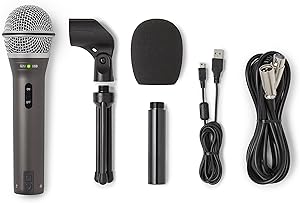
Samson Q2U
The practical podcast mic — dynamic capsule naturally rejects room noise, USB and XLR outputs, and costs half as much as the Yeti
Pros
- Dynamic capsule rejects off-axis room reflections and background noise far better than any condenser USB mic
- USB and XLR outputs — plug-and-play today, upgrades to an audio interface setup later without replacing the mic
- Built-in headphone jack with zero-latency monitoring included
- Comes complete with desk stand, mic clip, USB cable, and XLR cable — nothing else to buy to start recording
- Under $70 — significantly cheaper than the Blue Yeti for better real-world podcast performance
Cons
- Less detailed and full-sounding than the Blue Yeti in a treated room — condenser mics genuinely do capture more nuance in ideal conditions
- Single cardioid pattern only — no versatility for multi-person or non-standard recording scenarios
- Budget-level build quality compared to the Blue Yeti’s all-metal construction
Bottom line: For podcasters recording in typical home environments — untreated rooms, home offices, bedrooms — the Q2U produces cleaner, more usable audio than the Blue Yeti at half the price. The dynamic capsule’s natural room rejection solves the problem that sends most Blue Yeti users hunting for acoustic treatment. It’s the right starting mic for most podcasters.

Shure MV7+
Dynamic USB and XLR mic with broadcast-quality voicing — better room rejection than the Yeti, cleaner podcast sound at a sensible price step up
In this Blue Yeti review, we found the mic handles most voice recording scenarios well, though it picks up more room noise than dynamic alternatives in untreated spaces.
Pros
- Dynamic capsule with broadcast-tuned voicing — warm, present, and forgiving of imperfect room acoustics
- USB and XLR outputs — works without an interface today, upgrades cleanly to a full signal chain later
- ShurePlus MOTIV app adds real-time EQ, compression, and monitoring control directly from your phone or computer
- Built-in yoke mount and familiar SM7B-inspired form factor — straightforward boom arm compatibility
- Substantially better room performance than the Blue Yeti for podcast voice work
Cons
- At ~$249, it’s roughly double the Blue Yeti’s price — a meaningful budget step up
- Heavier than most USB mics; a decent boom arm is recommended rather than using a desk stand
Bottom line: If your budget allows stepping above both the Yeti and the Q2U, the MV7+ is the logical destination. It gives you the room rejection of a dynamic mic, the convenience of USB, the flexibility of XLR, and broadcast-quality voicing — all in one mic that won’t need replacing as your setup grows. It’s the USB mic that serious podcasters land on.
| Feature | Blue Yeti | Samson Q2U |
|---|---|---|
| Price | ~$130 | ~$70 |
| Capsule Type | Condenser | Dynamic |
| Polar Patterns | 4 (cardioid, omni, bidirectional, stereo) | 1 (cardioid only) |
| Connection | USB only | USB + XLR |
| Room Sensitivity | High — picks up reflections and background noise | Low — rejects off-axis noise naturally |
| Best Environment | Treated or acoustically decent room | Any room, including untreated home offices |
| Best For | Content creators wanting versatility in good rooms | Podcasters who want clean results in real-world spaces |
Should You Buy the Blue Yeti?
The honest breakdown
Buy the Blue Yeti if: You record in a treated or acoustically decent room — meaning soft furnishings, carpet, bookshelves, or a dedicated recording space. If you also want versatility beyond podcasting (interviews in cardioid, group discussions in omnidirectional, remote sessions in bidirectional), the four polar patterns are genuinely useful. It’s also a reasonable choice for voiceover, ASMR, or music recording where condenser detail is an asset.
Skip it if: You’re recording in a typical home office with hard walls, wood floors, or any noticeable echo. The condenser capsule will make your room sound worse, not better. The Samson Q2U at $70 will give you cleaner podcast audio in that environment, and the Shure MV7+ at ~$249 gives you the full dynamic USB upgrade.
The room test: Clap your hands once in your recording space and listen. If you hear any ring or echo, you’re in a room that will challenge the Blue Yeti. If the clap sounds dead and dry, the Yeti will perform well. Most home offices fail this test — which is why dynamic mics consistently outperform condensers for home podcast recording.
Condenser vs. Dynamic for Home Podcasters: The Real Difference
The most important mic decision for home podcasters isn’t brand or price — it’s capsule type. Condenser microphones are sensitive by design. They capture detail, nuance, and room ambience, which sounds impressive in a treated studio and actively harmful in a bare bedroom or home office. The Blue Yeti is a condenser. It will pick up your room.
Dynamic microphones are less sensitive. They focus on sound directly in front of the capsule and let room reflections and distant noise fall away. This makes them naturally forgiving in imperfect environments. For podcasters recording without acoustic treatment, dynamic mics consistently produce cleaner-sounding audio than condenser mics at the same price point — even if the condenser sounds more impressive on paper.
If you’re choosing between the Blue Yeti and a dynamic alternative like the Samson Q2U, the right choice depends almost entirely on your room. In a bad room, a $70 dynamic mic will sound better than a $130 condenser. That’s not a knock on the Yeti — it’s just physics.
Frequently Asked Questions
Is the Blue Yeti good enough for professional podcasting?
In a treated or acoustically decent room, yes — the Blue Yeti produces professional-quality audio that won’t hold back a well-produced podcast. The limitation is room acoustics: if you’re recording in a space with noticeable echo, the Yeti’s condenser capsule will make it worse. For untreated home offices, a dynamic mic will give you cleaner results.
Why does my Blue Yeti pick up so much background noise?
Because it’s a condenser microphone. Condenser mics are sensitive by design, and that sensitivity captures everything — your voice, your room, your HVAC system, keyboard clicks, and reflections off nearby walls. The fix is either improving your room acoustics (adding soft furnishings, recording in a closet, using acoustic panels) or switching to a dynamic mic that naturally rejects off-axis noise.
How far should I be from the Blue Yeti when recording?
4–8 inches is the typical recommendation. The Yeti is sensitive enough that you don’t need to be right on top of it, but getting closer reduces how much room sound it captures. The desktop stand that comes with the Yeti tends to position the mic too low and too far — a boom arm that lets you bring the mic to face level, directly in front of your mouth, will improve recordings noticeably.
Should I get the Blue Yeti or the Samson Q2U?
It depends entirely on your room. In a treated room or a space with good natural acoustics, the Blue Yeti’s condenser detail and four polar patterns justify the higher price. In a typical untreated home office — which describes most podcasters’ recording spaces — the Samson Q2U’s dynamic capsule will produce cleaner, more professional-sounding podcast audio at half the price. The Q2U also adds XLR output for future upgrades, which the Blue Yeti lacks entirely.
Is the Blue Yeti worth the price over cheaper USB mics?
In its target environment, yes. The Blue Yeti genuinely sounds better than $30–$50 USB condensers — it has a larger capsule, better preamp, more controls, and more durable construction. The value question isn’t Yeti vs. cheap USB mics; it’s Yeti vs. the Samson Q2U or Shure MV7+ for podcast-specific use. In that comparison, the Q2U offers better real-world performance for less money, and the MV7+ offers better performance for more.
Related Guides
- Rode NT-USB Mini vs Blue Yeti: Why the Yeti’s Reputation No Longer Holds Up
- Best USB Mic for Podcasting at Home: Plug In, Press Record, Sound Professional
- Best Podcast Mic Under $200: The Best-Sounding Mics You Can Actually Afford
- USB vs XLR Microphones: Which One Do You Actually Need?
Browse all guides in our Microphones Hub.
Related reading: Best Complete Podcast Setup Under $200: The G • Best Portable Audio Recorder for Podcasting: • Best Podcast Hosting Platform: Where to Actua
See how it stacks up in our Rode NT-USB Mini vs Blue Yeti comparison, or check Rtings’ Blue Yeti measurement data for objective audio specs.